
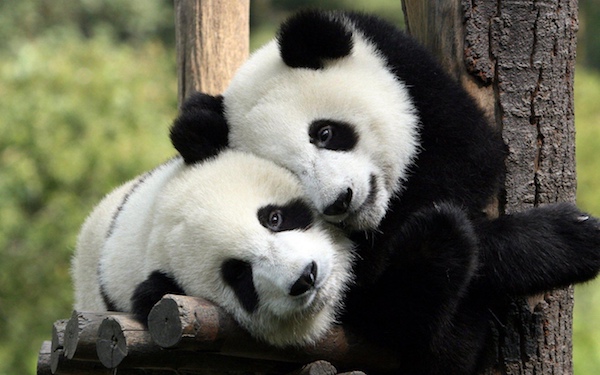
PANDA
The giant panda (Ailuropoda melanoleuca, also known as the panda bear (or simply the panda), is a bear native to South Central China. It is characterised by its bold black-and-white coat and rotund body. The name "giant panda" is sometimes used to distinguish it from the red panda, a neighboring musteloid. Though it belongs to the order Carnivora, the giant panda is a folivore, with bamboo shoots and leaves making up more than 99% of its diet. Giant pandas in the wild will occasionally eat other grasses, wild tubers, or even meat in the form of birds, rodents, or carrion. In captivity, they may receive honey, eggs, fish, yams, shrub leaves, oranges, or bananas along with specially prepared food.
Despite its taxonomic classification as a carnivoran, the giant panda's diet is primarily herbivorous, consisting almost exclusively of bamboo. However, the giant panda still has the digestive system of a carnivore, as well as carnivore-specific genes, and thus derives little energy and little protein from consumption of bamboo. Its ability to digest cellulose is ascribed to the microbes in its gut. Pandas are born with sterile intestines and require bacteria obtained from their mother's feces to digest vegetation. The giant panda is a highly specialised animal with unique adaptations, and has lived in bamboo forests for millions of years.The average giant panda eats as much as 9 to 14 kg (20 to 30 lb) of bamboo shoots a day to compensate for the limited energy content of its diet
WHERE WILL YOU FIND THEM?
You will find the panda at pen B22, west off the amphitheatre.